

Sheldon Cooper presents FUN with FLAGS (F1 edition)
- Snehanshn Hazarika

- Jul 8, 2020
- 4 min read
Updated: Jul 10, 2020
Flags have been a part of Formula 1 for as long as anyone can remember. These days because the cars travel so quickly, there is also a “backup system” of lights called the GPS Marshalling System which lights up with the relevant colour of each flag as the driver passes through the affected area of the circuit.
“But what do all these flags even mean??” is a question most of us had when we started watching F1 and so will the newcomers to this sport.


1. Chequered flag: The flag that all drivers want to see at end of a race. It indicates that the session is completed or quite simply “THE END OF THE RACE”, though it has a different meaning in qualifying. In qualifying, it means that you cannot start another lap as the allotted time for that particular session has expired. However, if you are already on a lap by the time this flag comes out, you can complete your (flying) lap.

2. Yellow Flag: This is the flag that you’ll see very often be it during free practice, qualifying, or the main race. The yellow flag is shown in case of any danger on the track, which could be due to a collision, due to a mechanical or electrical failure. The way the flag is waved also plays a crucial role and has different meanings.

- Single stationary yellow flag - DANGER AHEAD NEAR TRACK!!
- Single waved yellow flag - DANGER AHEAD ON TRACK!!

- Double waved yellow flags - DANGER AHEAD, TRACK BLOCKED AS PEOPLE MESSED UP!!
(NOTE: at all three scenarios, overtaking is prohibited and cars MUST slow down, failing to do so will be penalized)
3. Green flag- The polar opposite of the yellow flag. It means the track is clear of any danger or debris resulting from the previous yellow flag(s) necessity. Drivers can get back up to racing speeds and overtaking can be resumed. In case of a full-course yellow (or safety car), the green flag is shown at all stations for the following whole lap. It is also shown at the start of a session on free practice days and qualifying., and also during the formation lap.

4. Red flag- The most serious flag of all (as you might have already guessed). Seeing a red flag means - SESSION HAS BEEN HALTED OR SUSPENDED!!. Bad weather conditions, poor track conditions, or an accident on the track warrants the use of a red flag.

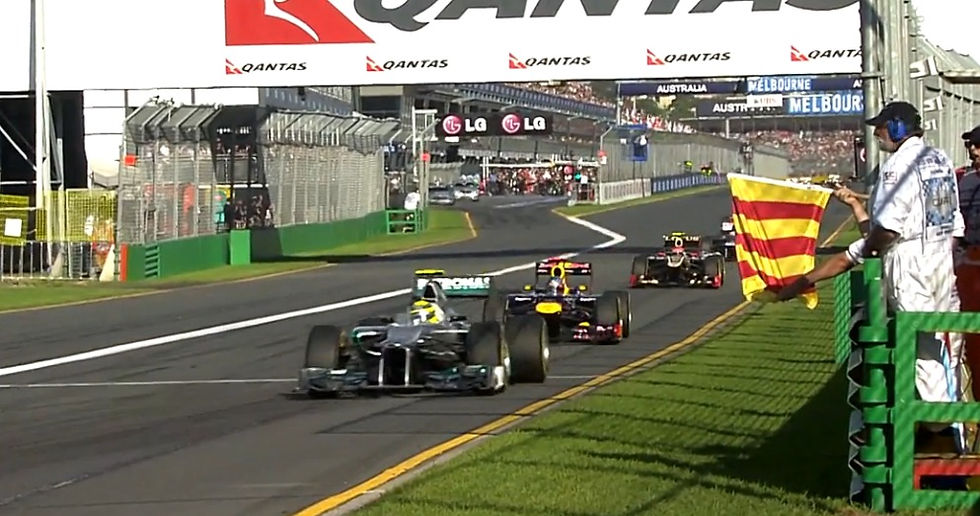
5. Red and Yellow flag- “Watch out!! Slippery track surface ahead” usually due to some oil or water. Can be seen 'rocked' from side-to-side (not waved) to indicate a small animal on track. Wouldn’t want an animal cruelty case from the PETA to ruin the fun.
6. Black with orange circle flag- A flag that you won’t see that often, together with the car number. This flag indicates that the car is damaged, driver has a mechanical problem and must return to pits as soon as possible.

7. Black flag- Another flag that you won’t see that often, together again with the car number. It means that the driver is disqualified and must return to pits immediately!!
If “you have been called to the principal’s office” had a flag, this would be it.

8. Half black-half white flag- This is a flag for the bad boys. "The Final Warning". This flag is shown to warn the driver of unsportsmanlike conduct. Possibility of being followed by a black flag upon further infringement. And of course, it is too accompanied by the car number.

9. White flag- The white flag will be shown when a slow-moving vehicle is on the circuit, such as an ambulance, a tow truck, or a course car. Another time where it is often waved is on the last corner during free practice when drivers do practice starts.

(The 2013 Canadian GP was marred by the death of track marshal Mark Robinson, who was run over by the recovery vehicle moments after this picture. The accident happened while marshals were removing the wreckage of Esteban Gutiérrez who had spun off during the closing stages of the race. Robinson died later in hospital)
10. Blue flag- The most common and controversial flag that you will see. The waving of this flag is shown to a car that is about to be lapped by a faster car. The slower car MUST ALLOW the faster car to pass before the show of THREE CONSECUTIVE blue flags or risk being awarded a penalty.
If “GTFO mate!!” had a flag, it would be this one. Often the top drivers get really hot under the collar if this is not adhered to properly.
Also, in free practice and qualifying this flag counts as the fastest lap (until then). Occasionally, the blue flag is also shown at the exit of the pit lane to warn the driver of a faster car present on the racing line.

Hopefully, by now you have learned much more of the flags used in Formula 1. Next time you’re watching a Grand Prix, see if you can spot the Marshalls waving these flags or better still look for the lights on the dash display during the on-board camera scenes.


Comments